Use Cases
Rassket is built for five energy-specific problems. Each use case gets specialized feature engineering, a purpose-built prediction approach, and results explained in the context of your grid and your utility.
1. Day-Ahead Load Forecasting
What is this? Predicting system load or demand for the next trading day — and similar short-to-medium horizons like 48-hour or weekly demand.
What Rassket does:
- Automatically creates time-of-use window features — peak, shoulder, and off-peak indicators
- Adds public holiday indicators for your region
- Generates lag features — load from 24 hours ago, 7 days ago, and seasonal equivalents
- Applies weather interaction terms where temperature and humidity data is present
- Trains with time-aware cross-validation so the model never sees future data during training
What you get:
- Hourly or sub-hourly load forecast with upper and lower confidence intervals
- Feature importance — which hours, days, and seasonal signals drive the forecast
- PDF report and CSV export ready for your operations team
2. Solar / Wind Generation Forecasting
What is this? Predicting variable renewable output — including curtailment risk and generation uncertainty — for dispatch planning and grid balancing.
What Rassket does:
- Builds weather interaction features from temperature, cloud cover, and wind speed where available
- Generates seasonality features capturing daily and annual solar cycles
- Creates curtailment-aware lag features for wind generation patterns
- Produces forecast intervals that capture the wider uncertainty typical of renewable generation
What you get:
- Generation forecast with uncertainty bands
- Feature importance explaining which weather signals drive generation
- Export to CSV and PDF for integration with dispatch planning tools
3. Energy Theft / Meter Fraud Detection
What is this? Detecting anomalies, meter tampering, diversion, and non-technical losses in metering data — without manually reviewing every account.
What Rassket does:
- Identifies consumption patterns that deviate significantly from expected behavior
- Builds features from meter reading sequences that flag sudden drops or inconsistencies
- Applies domain-appropriate detection methods trained on your actual metering data
- Ranks accounts by anomaly score so your team can prioritize investigations
What you get:
- Anomaly scores with confidence levels for each account or meter
- Feature importance showing which signal patterns drove the detection
- Export-ready list for field investigation teams
4. Predictive Maintenance (Turbines)
What is this? Detecting early warning signs of asset failure in rotating equipment — turbines, generators, and other field assets — before the failure happens.
What Rassket does:
- Processes vibration, temperature, pressure, and other condition monitoring signals
- Creates rolling statistics — moving averages and standard deviations — that surface degradation trends
- Builds lag features that capture how asset health is changing over time
- Detects deviations from normal operating ranges before they become failures
What you get:
- Condition score over time with confidence intervals
- Feature importance showing which signals are most predictive of failure
- PDF maintenance report and API output for CMMS integration
5. Short-Term Electricity Price Forecasting
What is this? Predicting LMP, hub prices, or tariff-linked prices over short horizons — for procurement, trading, and rate optimization.
What Rassket does:
- Models price movements using load, generation mix, and historical price signals
- Creates time-of-use and congestion-pattern features relevant to your market
- Applies your utility's operational context to focus on the price signals that matter for your grid
- Produces confidence intervals that capture price spike risk
What you get:
- Price forecast with upper and lower bounds
- Feature importance explaining which market signals drive the forecast
- CSV and PDF export for procurement and trading teams
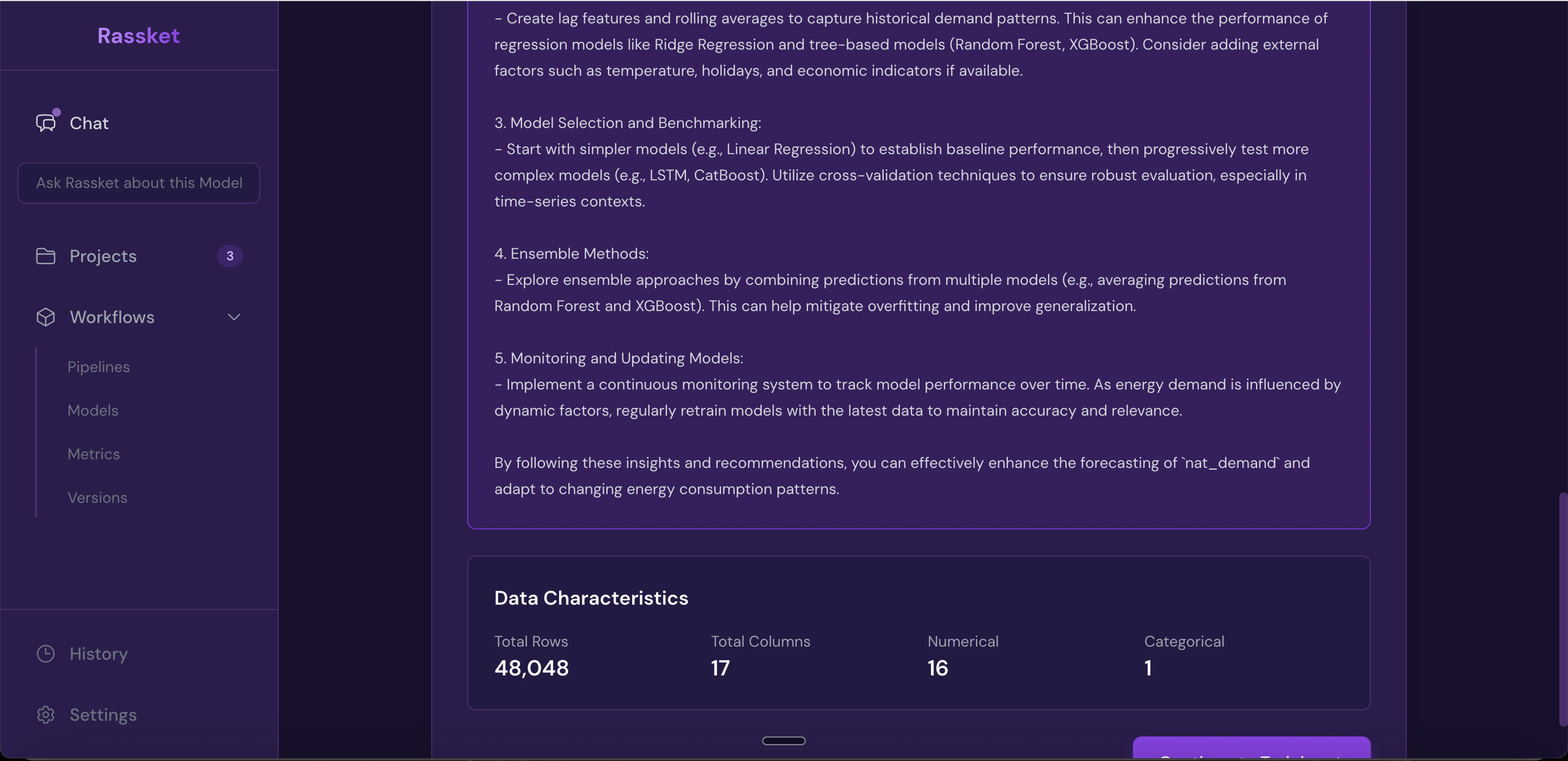
Rassket delivers forecast curves, confidence intervals, and plain-English explanations for each energy use case.
What All Use Cases Share
- No coding required — connect your data and select your use case; Rassket handles everything else
- Utility context applied automatically — your operational context shapes every forecast and explanation
- Plain-English results — forecasts and feature importance explained without technical jargon
- Export-ready outputs — PDF, CSV, and API for every use case
- Under 30 minutes to first forecast — from raw data to production-ready results
Getting Started
- Go to Getting Started to upload your data or connect a database
- Select your energy use case and utility on the Domain Selection screen
- Follow the How It Works guide through preprocessing, analysis, training, and results
- Use Operations for peaks, action windows, and alerts once your model is live